Scott Kaufman

PhD Environmental Engineering · Baltimore, MD

Thirty years from a Vermont compost pile to the GHG Protocol table — and the road does not end at the company. It forks.

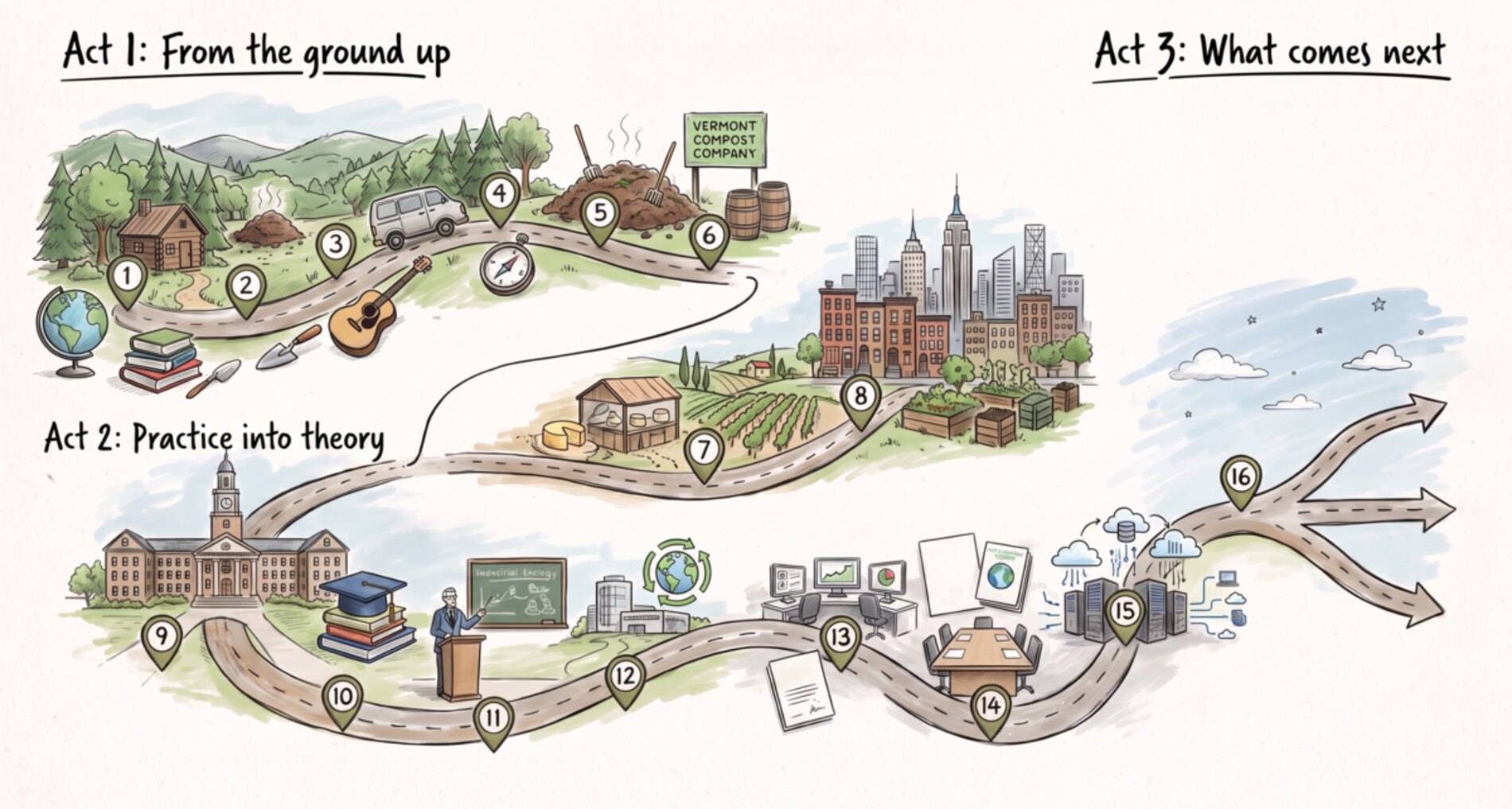
An illustrated winding road showing Scott Kaufman's career in three acts: From the Ground Up, covering international study, AmeriCorps, a forty-city open mic tour, discovering composting in the Green Mountains, apprenticing at Vermont Compost Company, goat farming in France, and the Manhattan Master Composter Program; Practice into Theory, covering Recyclebank, teaching Industrial Ecology at Columbia, the GHG Protocol and PAS 2050 working groups, and the Carbon Trust with clients including Walmart, Cargill and AMD; and What Comes Next, covering fifteen years at Stacks Data and the PPVIS consortium, ending at an unresolved fork in the road marked with question marks.
The Winding Road · 1991–presentEvery stop is written out in full below.

Hands first, theory after

He learned composting from a loader seat before he learned to model it, and studied municipal waste systems only after collecting from them. The expertise is built from the material end up, which is why it survives contact with an operating site.

Rooms of people who disagree

The Beverage Industry Environmental Roundtable, the GHG Protocol working groups, and fifteen years of PPVIS are the same job in different clothes: getting organizations with opposed interests to commit to one method and stay committed.

The data problem, from every side

Every chapter hit the same wall — the number you need exists somewhere and cannot be reached. He met it as a field operator, a researcher, a consultant and a standard-setter, then spent fifteen years building against it.

The full record

N-01 1991–95 THE ROAD

He read International Studies through New College, Hofstra's alternative liberal-arts college. Sophomore year brought the European Odyssey, ten weeks travelling Western Europe meeting academics and politicians while studying a European Union still in its formative years. Brussels made the strongest impression.

Junior year at the University of Amsterdam on scholarship — European history, politics, literature, and the first long stretch living inside another culture. Senior year at Oxford, two trimesters carrying a full year of credit. Afterward, months alone through southwestern Europe and into the Middle East.

N-02 1995–96 THE ROAD

Ordered, set up and configured the organization's computers and networks, and tutored international immigrants.

The music deepened here — writing heavily, performing, and eventually running an open mic night in downtown Montpelier. When the bar closed, the restlessness returned.

N-03 1996–97 THE ROAD

A deliberate collision of the two things he could not sit still about. Open mics in more than forty cities, plus rural stops wherever he could find a way to play.

He calls it among the foremost experiences of his life — where he learned his own abilities, how he faces a challenge, and how to clear his mind and act on that clarity.

N-04 1997 THE ROAD

A tiny sublet near his songwriting partner to finish recording two years of songs, playing live as an acoustic duo.

The honest part: pushing the music in front of people was a struggle he did not enjoy, because he was pressuring himself to get discovered rather than enjoying the playing. A lesson that would take decades to learn.

N-05 1997–98 FIELD

Back in Vermont, rotating through temp jobs, he landed in the office of a waste company sited inside one of its own landfills. Little prior exposure to environmentalism; he became quickly both enthralled and alarmed. Composting was the catalyst — unfamiliar to him growing up on Long Island, and in his view the most elegant solution to human organic waste that could exist.

When I looked up and saw the belching methane flares and the line of garbage trucks snaking through windy dirt roads in the lush Vermont forest, my inner passion for these issues was officially ignited.

One morning, doing paperwork in that office with the sun breaking through onto his face, he decided he would start a company collecting food waste from homes and selling the compost back. He would call it the Vermont Compost Company, and believed the idea was his alone.

On the wall of the same office hung a poster for the Vermont recycling hotline. He called it and described the plan. The woman on the line told him he ought to talk to a man named Karl Hammer in Montpelier — who ran a business called the Vermont Compost Company, doing precisely that. He called Karl the same day. Karl told him it sounded like he had a calling, and to come visit.

N-06 1998–2000 FIELD

Two years apprenticing on Karl Hammer's composting farm without pay, supported by a part-time office manager role — bookkeeping, grant writing, invoicing, customer relations.

In the yard: Ben & Jerry's ice cream waste, manure of every source, landscaping waste from across central Vermont. He learned to run bucket loaders and their attachments and to drive trucks delivering material across the region, often in punishing winter. On Hammer: one of the most dynamic, intelligent and driven individuals I have ever known.

The capstone was a closed-loop food scrap program the two of them built: laying hens as the seed, restaurant food waste collected at first in his Toyota Camry, the birds eating what they wanted, the remainder composted with their manure, and the eggs sold back to the same restaurants. He wrote and won the Vermont Agency of Natural Resources grant that funded it, and reported tonnages back to the agency.

N-07 2000–01 FIELD

He had met a woman making goat cheese in northern Vermont who learned it apprenticing in France, and copied the idea outright — signing up for Willing Workers on Organic Farms and enlisting an old French friend from his Amsterdam year to find him a farm.

Six months milking thirty goats and half a dozen cows morning and evening, making the farm's cheeses, selling them at markets in medieval towns. He is straightforward that it was also foreign, hard, and isolating. Afterward he travelled south through France and Italy and again through the Middle East until the money ran out.

N-08 2001–03 FIELD

He found it by cold-calling. Ringing around New York for composting work, he came across a program at the Brooklyn Botanic Garden and phoned them; the woman who answered told him Sanitation and the New York Botanical Garden were at that moment starting a Manhattan compost project and looking for someone to run it, and handed him a contact.

He ran it: outreach, education, and experimental composting in one of the densest places in the country, mostly community gardeners learning to compost. What he valued was the range of people it put him in front of, at every socioeconomic level.

It also produced the hinge. Professor Nicholas Themelis of Columbia was exploring an in-vessel composter for the campus. After 9/11 the funding for Scott's position was cut; at a meeting he told Themelis that if they wanted to act they should act soon. Themelis offered him a job on the spot. Scott counter-proposed coming as a student — and, with no engineering background at all, had to shore up his basic science, sit the GREs, and apply through the normal channels.

N-09 2003–05 RESEARCH

VC Paper, an Australian company known in New York for the recycled corrugated cardboard plant it ran on Staten Island, sponsored the degree in exchange for a project: map the flows of waste paper — the plant's feedstock — through New York City, and find the untapped sources.

It took him through the working interior of the city's waste infrastructure and everyone in it. In his words: and yes, I mean including the mafia.

It is also where he found life cycle analysis, alongside the material flow analysis he was already using. LCA married the things that drew him to the field — practical and theoretical, hands-on and analytical at once — and became the foundation of everything after.

N-10 2004–06 RESEARCH

Joined the recycling-rewards pioneer at its founding. Advised the founders on strategy and on where the company sat within the waste industry, and ran waste characterization studies along Philadelphia collection routes to establish baseline recycling rates for the first municipal pilot.

N-11 2005–08 RESEARCH

He used LCA to build a way for cities to quantify how well their waste systems actually perform. The result was Resource Conservation Efficiency: emissions from collecting and treating municipal solid waste measured against the derived minimum possible, expressed as a ratio.

Part of the work was sponsored by EPA Region 9 — and he ended up at ideological odds with his own funder. His conclusion was that, given what cities actually face, waste-to-energy plants are essential: deeply unpopular in the San Francisco-led Region 9 offices. He kept the friendships, and describes it as the thing that sharpened his ability to cut through noise and look at a problem as an engineer.

Paul Brunner of TU Vienna, perhaps the world's foremost material flow analysis expert, served as a thesis advisor; Scott spent two months in Vienna with his team shoring up the flows work at the centre of the thesis. Defended 2008, three papers published from it.

N-12 2008–11 RESEARCH

Of everything at Columbia he names this the peak: without a doubt the peak experience and my favorite thing about having studied and worked there.

Themelis had taught the course for years; Scott rewrote the curriculum from the bottom up. His framing: industrial ecology is the soil out of which LCA grows.

The guest list is his own career in miniature. Year one, mostly colleagues from other academic departments. By years two and three, once the PepsiCo network opened, an all-star roster of economists, academics, and industry leaders. Course evaluation 4.43 / 5.00.

N-13 2007–08 STANDARDS

PepsiCo approached the department for help building a life cycle carbon footprint program for its products; Scott was chosen to lead it. That put him inside the foremost efforts of the moment: World Resources Institute greenhouse gas work and the Carbon Trust's PAS 2050 product footprinting standard.

He sat in working groups for both — in his own careful phrasing, my own small contribution to the global standards that everyone recognizes to this day. He also led Beverage Industry Environmental Roundtable work on sector-specific GHG Protocol guidance: an early lesson in getting competitors to agree on one method.

He stayed a further year as a postdoc sponsored by PepsiCo, and credits this period with opening the whole world of corporate sustainability to him.

N-14 2009–11 STANDARDS

A quasi-governmental for-profit built to grease the wheels for industries trying to cut their climate impact. They owned both the product carbon footprinting program and the PAS 2050 standard guiding it, and PepsiCo was their client — which is how he met them.

He joined to build their product carbon footprinting business across North and South America, and recruited and signed Cargill, Coca-Cola, Walmart, and AMD, among others. He calls it career-defining, without qualification.

N-15 2011– DATA

The same wall kept appearing. The GHG Protocol, PAS 2050, the Walmart Sustainability Consortium, individual companies, and the LCA models he ran almost daily — every one needed large volumes of trustworthy, verifiable data, and every one struggled to get it.

Two problems underneath all of it. There was no central place to find the data. And even if there had been, there was no trustworthy or practical way to move it. That is the company.

Fifteen years building supply chain sustainability and compliance software for manufacturers in paper and chemicals. Current customers include Sappi and UPM; the platform scaled past 350 corporate compliance users. He built and managed a team of seven to eight in the company's larger era, and carried full financial and operational accountability throughout, reporting to an investor board of two principals holding competing visions for the business.

The work he is proudest of is PPVIS: a consortium peaking at roughly fifteen competing manufacturers — Solenis, Kemira, Omya, Saica among them — all reporting into one shared program and held together for over a decade. Getting competitors to share data they would rather keep is the hardest and most useful thing he knows how to do.

Publications & standards work